
Logic app user guide
API in Data platform
In the data platform, APIs are used as connectors to exchange data with all applications of Wavestone IT.
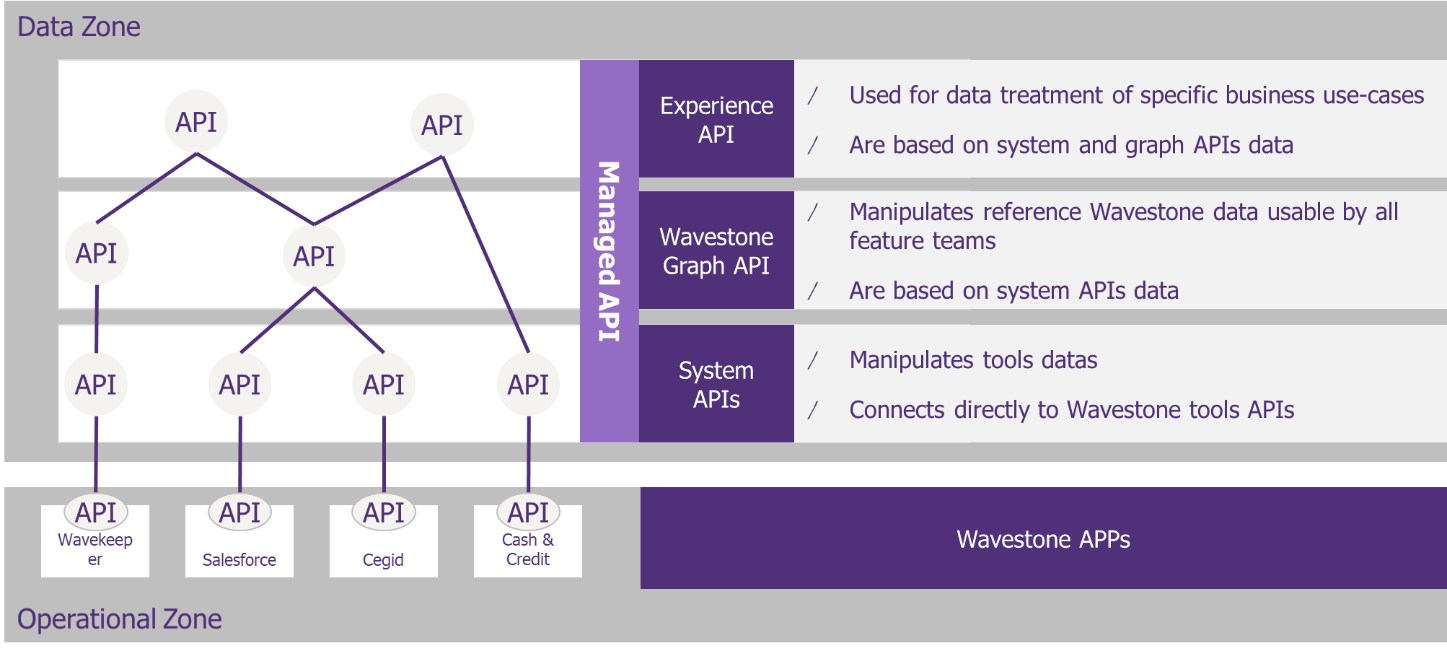
There are 3 types of APIs managed at Wavestone:
/ System APIs represent the lowest layer of APIs that allow the manipulation of data from Wavestone tools (ex: table hr_employee in Wavekeeper, object portfolio in Salesforce). They are directly connected to Wavestone tools’ APIs
/ Graph APIs represent the intermediate layer of API. Their goal is to manipulate and expose Wavestone reference data – accounts, employees. To do so, they interact with System API – through middleware – and concentrate multiple routes utilities into a single one. They expose user-friendly datasets that follow Wavestone standards. They must be agnostic to tools – a user does not have to know where the data is loaded when using a standard object on a Graph API. In the end, Graph APIs present standard data models and allows the client to interact with multiple System API in a single request.
/ Experience APIs are the top layer of Wavestone APIs. They fulfill specific business use cases using Wavestone standard objects (synchronization of data, provision of a specifying view for reporting, etc.). To do so, they manipulate standard Wavestone objects calling Graph API route.
Example
As an example, let’s say you have an employee object composed of two property:
Email, retrieved from Smartrecruiters
Name, retrieved from Wavekeeper
This object is exposed through a Graph API. When called, it will make a call to both SmartRecruiters and Wavekeeper System API to retrieve the necessary information. One graph API provides information based on two system API.